


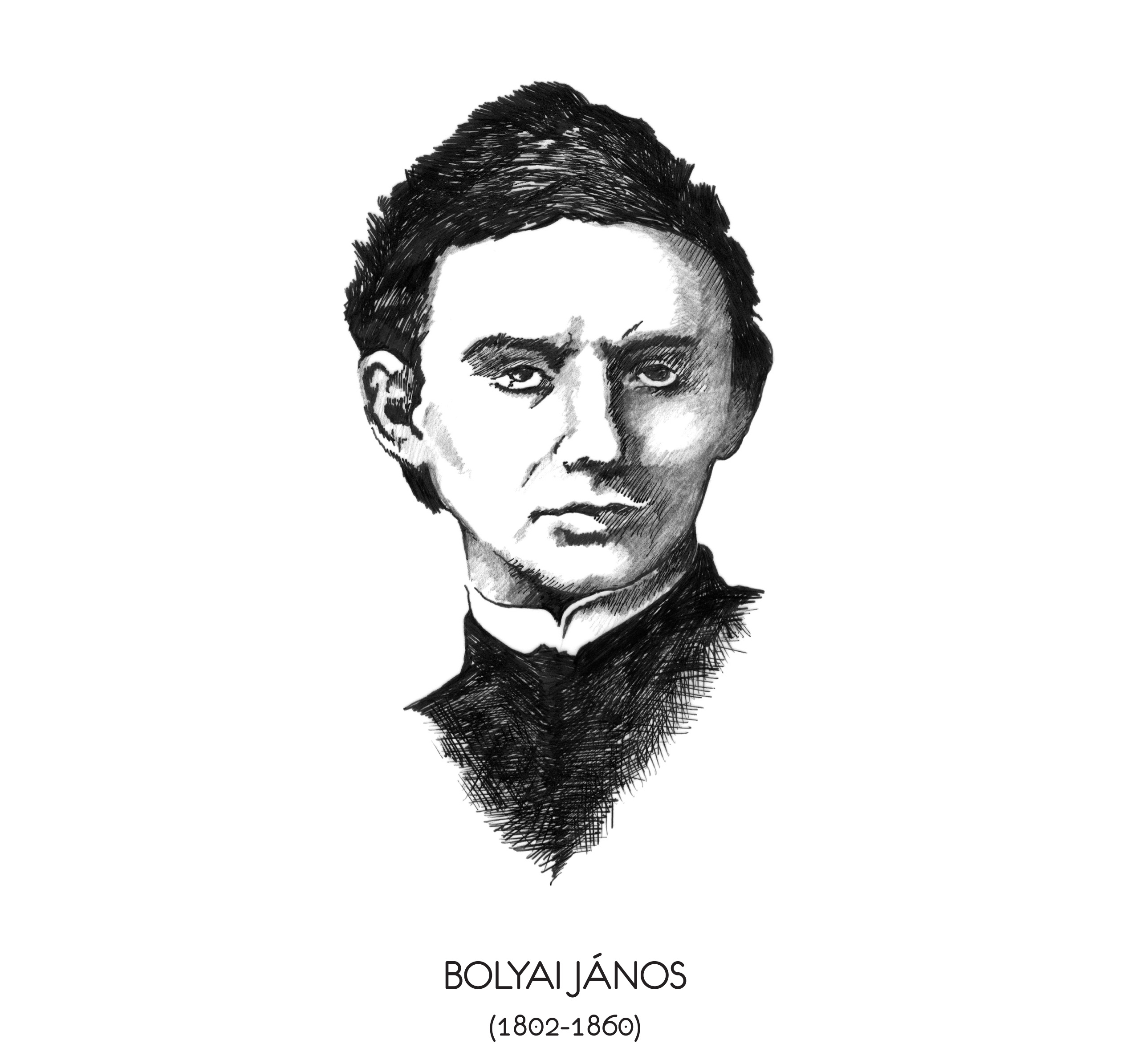
 Engineering officer, mathematician, creator of the non-Euclidian geometry.
He was born in her mother, Zsuzsanna Árkosi Benkő’s house in Kolozsvár (today Cluj-Napoca, Romania) His father, Farkas Bolyai (1775–1856) was an outstanding mathematician of his time. He came from a Hungarian family from Eastern Transylvania. Their family-tree can be traced back until 1276. They had an estate near Nagyszeben (today Sibiu Romania) which provided them a modest living. Between 1796–1799 Farkas Bolyai went to Göttingen, which was considered the capital of mathematics. This is where he met Carl Friedrich Gauss. They kept in touch even after Bolyai went home.
At the age of 12 János Bolyai went to study to his father’s school, at the Protestant College in Marosvásárhely (today Târgu-Mureş, Romania). He skipped the first three years, and went straight to the fourth grade. He was a true infant prodigy, at the age of 15 he worked out a method for the division of the angle into three parts out. His father wanted him to study in Göttingen, but from his teacher’s salary he could not afford to send his son to Göttingen. János Bolyai went to the Military Academy in Vienna, from which he graduated with excellent results in 1823 and became an officer of the engineer corps. He continued his studies for one more year. He became sub-lieutenant and started working with the board of directors of the fortification works.
We can find out from the Reise Journal that his trip fromVienna to Temesvár (today Timişoara, Romania) lasted 13 days, from September 17, 1823 until September 30, 1823 and cost 36 Forints. The letter is not important, but the dates certainly are. Antal Dóczy, engineering lieutenant-colonel, the manager of the fortification works in Temesvar sent him to start his work as a military architect under the guidance of engineering first captains Joseph Krieger and Boldizsár Schilling. This was time-consuming, but the captains were good professionals. It was here, that Bolyai gained practice in the field of military engineering.
In his letter written to his father on November 3, 1823 he wrote: „Out of nothing I have created a strange new universe”. He created the absolute geometry, i.e. the geometry independent from parallel theories, shortly before coming to Temesvár. He fully developed the theory in Temesvár and Arad, where he was sent in 1826. We also know that Antal Dóczy, the commander of Temesvár was not fully satisfied with his work – since Bolyai was more interested in his working on his revolutionary theories rather than in the bureaucracy concerning the reconstruction of the fortress. This proves that the theories he wrote– encouraged by his father -during his holiday between December 1830 and May 1831 were developed in Banat county. His work of 29 pages in Latin on absolute geometry, i.e. the hyperbolic geometry was published as an appendix in his father’s dissertation Tentamen in 1832. The title was: Appendix. Scientiam spatii absolute veram exhibens… i.e. „The true absolute science of the space…” Bolyai finished writing his Appendix in 1829.
But Bolayi’s life took a sad turning-point. Banat county was marshy, especially the fortress in Temesvár surrounded by trenches and also the fortress in Arad were the source of the malaria. According to documents, in 1826 and between 1829-1830 there was an epidemic of malaria. It was then, that this „tall, strong and handsome boy” as his father described him, contracted malaria and rheumatism, with which he struggled for the rest of his life. Other diseases were added to this, which certainly gave enough work for the historiographers in the filed of medicine. It was said that military life was an easy one. It was not true for Bolyai, as other situations weren’t either.
He continued having financial and family problems. Although he lived an isolated life, he did not give up his scientific work. The Jablonowski Society in Leipzig put up an appointment for a competition regarding the clarification of the role of complex numbers. In 1837 János Bolyai sent them an 8 page competition essay entitled Responsio (Answer). With this work he was also ahead of his time: he clarified the geometrical role of complex numbers. With this work he became, together with Hamilton, the founder of the theory regarding the geometrical role of complex numbers. Tibor Toró, Physicist from Timişoara and outer member of the Hungarian Academy of Sciences drew the attention to one of Bolyai’s manuscript in which Bolyai discovered – and ahead proved to be a genius -the connection between the gravitation field and the geometric configuration.
He died alone on January 29, 1860, in Marosvásárhely. The following was written in the register of death: „János Bolyai, retired Captain Ingenieur – died in meningitis and pneumonia. -He was a famous and brilliant mathematician. The very first in his field. How sad that his great talent was buried with him without having been explored.”
No original portrait of Bolyai survives. The one, on the facade of the Palace of Culture in Târgu Mureş is considered to be the most authentic portrait of Bolyai. It is said that there are 25000 writings about the life and work of two Bolyais’. Due to the efforts made by architect Ferenc Smidt, the German mathematician Paul Stäckel, professor at the University of Königsberg, and then Heidelberg was the first who processed the Bolyai–legacy. His two volume work published in 1913 in German is still the most important Bolyai-monograph.
It is said that the architect Antal Schmidt knew Bolyai before he became ill and said that the engineering officer from Transylvania was able to cut with his Damascus blade the nail heads in the door-post with only one cut. Bolyai was portrayed as being „unstoppable” and this legend fits into the picture drawn about him. But what really mattered was that Smidt Antal was the father of Ferenc Smidt who became the propagator of the two Bolyai, especially of the life and work of János Bolyai. And here, the life and work of János Bolyai is connected to Temesvár again. It is here, where Alajos Privorszky, for the first time in the country, made researches concerning the consequences in the field of Physics of non-Euclidian geometry.
János Bolyai was one of the most important scientists of Europe. In Timişoara a commemorative tablet in five languages and a statue honours his memory.
